



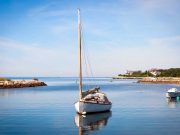


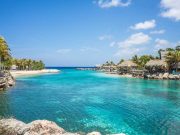

In the late afternoon, when work ends and the air cools, people head to Santa Maria beach to play soccer. They find a flat stretch of white sand above the tide line, mark goals with black volcanic stones and let the game grow as locals drift in. Fishing boats dot the horizon, teens leap off the pier into turquoise shallows, and barbecues send smoke across the shore. Regulars—hotel staff, cooks, bartenders—often bring nothing more than a towel, and tourists who spent the day at nearby resorts sometimes step into matches alongside those who served them.
Leonardo Lopez, a 25-year-old hotel receptionist who grew up nearby, says the rhythm is simple: enjoy the sunset, then play until the ball disappears with the last light. Sun sets late in Cape Verde, the archipelago lying roughly 500 miles off the West African coast, which makes for long evenings on the sand.
For some players, the beach is also where their careers began. Sidny Lopes-Cabral, born in the Netherlands to Cape Verdean parents, learned the game on Tarrafal Beach, a palm-fringed cove at the foot of Santiago Island’s mountains. He now plays for a leading Lisbon club and stars for Cape Verde’s national team. His memories of barefoot games on Tarrafal feel like a circle coming full around when he pulls on the national jersey.
Cape Verde will make its first appearance at the 2026 World Cup, and the country is eager to show itself beyond postcard beaches and dramatic peaks. As underdogs, the team faces heavyweights in the tournament opener—an opportunity to display a story rooted in islands where casual beach matches helped shape a generation of players. When qualification was secured, scenes of jubilation erupted on Quebra Canela Beach as fans greeted the squad in celebration.
The islands are shaped by a layered history. Most people speak kriol at home, while Portuguese remains the official language taught in schools, a legacy of colonial rule that began in the 15th century. Cidade Velha, on Santiago’s south shore, is the country’s only UNESCO World Heritage site: an early European settlement with cobbled streets, old churches and the haunting Forte Real de São Filipe, where enslaved Africans were once held before being sold across the Atlantic.
After independence from Portugal in 1975, Cape Verde leaned into its greatest resource—natural beauty. Tourism now accounts for roughly a quarter of GDP and about a third of jobs, more than twice the contribution of any other sector. The local spirit of morabeza—a relaxed hospitality—draws visitors, especially from Western Europe, who come for volcano hikes, snorkeling with turtles and long empty beaches that feel private even in high season. The national population is about half a million, and residents say the islands rarely feel crowded.
Beach soccer itself is a particular expression of that relaxed culture: informal, open to anyone, and forgiving. Games start small—showcasing tricks and fancy footwork—then expand into more organized contests as more people join. Sand slows movement, changing the game: there are fewer tackles, no goalkeepers or corner-kick rituals, and disagreements are rare. Joining is as simple as stepping onto the sand and making eye contact; language is rarely a barrier.
On soft sand, players attempt bicycle kicks, headers and audacious flicks they wouldn’t risk on pavement. With roughly 600 miles of coastline across the islands, there is room for soccer alongside volleyball nets, runners and family gatherings with grilled chicken and capirinhas. For many locals, the beach is the social hub where visitors and residents meet.
Last year Cape Verde welcomed a record number of visitors—over a million—and the country is preparing for more. By early 2025, thousands of hotel rooms were under development and vacation rentals multiplied, with popular beachfront properties commanding premium rates. Locals like César Frederico, who runs a restaurant on Quebra Canela, see tourism as vital: an economic lifeline for an island nation with limited natural resources beyond sun and sea. Entrepreneurs such as Lina Iliano, who founded Cabo Mundo Tours after moving from Belgium, promote island-hopping experiences that take visitors beyond resorts to Fogo’s craters, Santo Antão’s valleys, and Mindelo’s neoclassical streets.
The national team wears jerseys patterned with triangles inspired by flight routes between the islands—a visual nod to the connections that bind Cape Verde’s dispersed communities. Many players are part of a global diaspora: fewer than half of the squad were born on the islands, and most play for clubs in Europe. Still, wearing the blue of Cape Verde is a point of pride and a way to reconnect with roots. Roberto “Pico” Lopes, born in Ireland, describes how joining the national setup brought him closer to family on Santiago; relatives he’d never met now come to watch him play in Praia.
Even so, not every international star wants to jump into a sand match. Some prefer to relax and let the regulars—often youth who grew up playing on the beaches—take the show. The skill level among local beach players can be surprisingly high, and many professionals admit a healthy respect for the kids who grew up on the sand.
Beach soccer in Cape Verde is more than recreation. It’s a cultural workshop where movement, community and joy shape players and fans alike. As the islands step onto the World Cup stage, the global spotlight will highlight more than just their scenery: it will reveal the everyday places—shorelines and makeshift pitches—that helped build a national love for the game.