







After decades of planning and construction, Egypt’s Grand Egyptian Museum (GEM) has formally opened its doors. The colossal project — reported as a $1 billion investment and the world’s largest museum dedicated to a single civilization — brings together more than 100,000 artifacts under one roof and aims to become a cultural landmark beside the Pyramids of Giza.
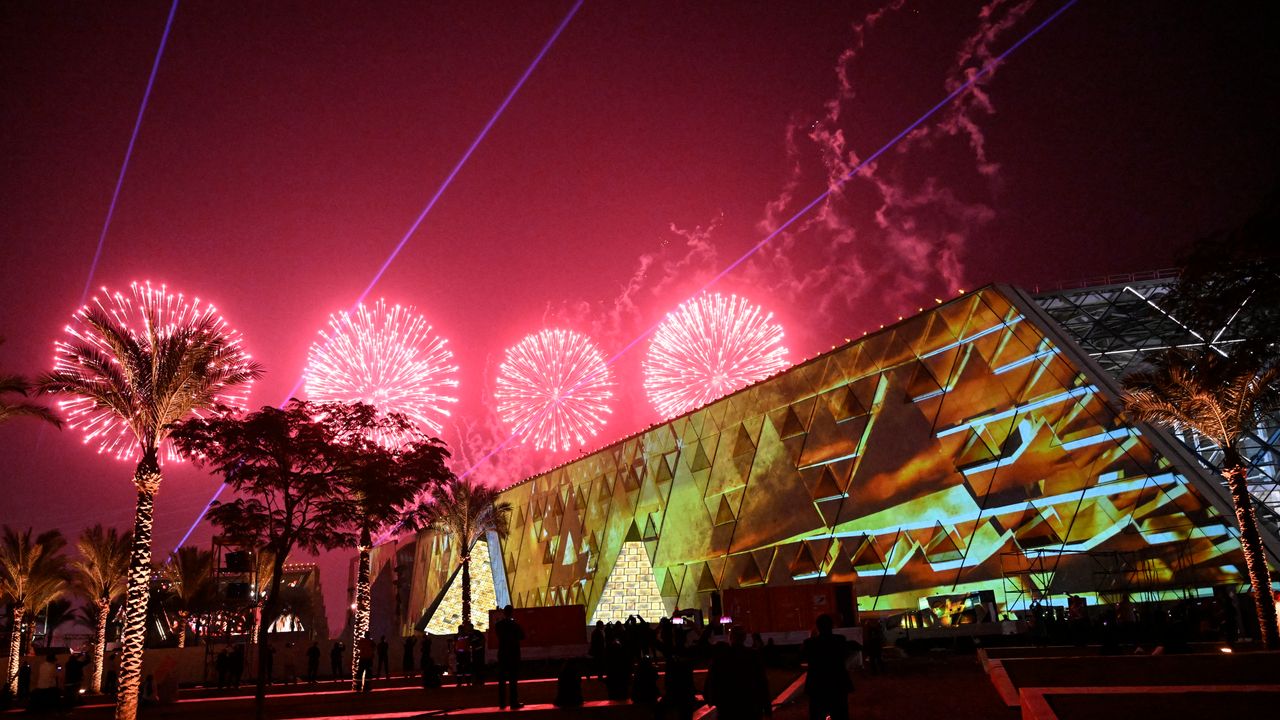
A star-studded inauguration ceremony drew royals, presidents, prime ministers and delegations from dozens of countries. The outdoor celebration, staged beside the museum’s 110-ton hanging obelisk roughly a mile from the Giza plateau, featured a dramatic laser and fireworks display that illuminated the pyramids and evoked the organizers’ hope that the GEM will stand as a ‘fourth pyramid.’
The evening blended spectacle with a message of cultural outreach. Egyptian president Abdel Fattah El-Sisi emphasized peace, security and cultural cooperation as foundations for flourishing knowledge and civilization. A flyover of ultralight planes bannered the sky with ‘welcome to the land of peace.’ Two orchestras performed—one at the GEM and another at the foot of the Great Sphinx—accompanying an original score titled Message for Peace by composer Hisham Nazih and conducted by Nayer Nagui. Dancers filmed in cities such as Tokyo, Paris, Sydney, Rio de Janeiro and New York were projected during the ceremony, underscoring Egypt’s global cultural connections. Several historic sites across the country were lit for the occasion, including temples in Luxor and Upper Egypt and landmarks in Cairo.
The program also highlighted Egyptian talent: operatic soprano Fatma Said, violinists Amira and Mariam Abouzahra, traditional whirling dervishes and Nubian performers were among those who appeared. A filmed narrative followed a young boy walking through the museum, previewing the treasures inside and culminating in the Khufu solar boats and the Tutankhamun collection, which will be shown to the public in full beginning Tuesday, November 4. After the ceremony, world leaders and VIP guests toured the galleries in private visits.
Spanning roughly 5 million square feet, the GEM complex includes a hanging obelisk plaza, a main atrium dominated by a 36-foot-high, 83-ton statue of Ramses II, a grand staircase lined with colossal sculptures, 12 principal galleries covering prehistoric through Graeco-Roman eras, a Children’s Museum, a dedicated Tutankhamun Gallery, the Solar Boats Museum, the Middle East’s largest conservation and restoration center, exhibition halls and conference facilities. Egyptology professor Salima Ikram described the museum as ‘phenomenal’ for the variety, quality and number of objects on display.
Among the most anticipated highlights is the Tutankhamun Gallery, where more than 5,900 objects from the boy king’s tomb will be exhibited together for the first time since Howard Carter’s discovery in 1922. Iconic pieces such as Tutankhamun’s golden mask, chariot and throne have been relocated from the century-old Egyptian Museum in Cairo’s Tahrir Square to the GEM. The two Khufu solar boats — ancient vessels associated with the builder of the Great Pyramid — were carefully transferred and restored; one had been on display near the Giza site and the other reassembled from pieces over several years.
The GEM’s origins reach back decades. Plans were first announced in 1992 and a foundation stone was laid years later; construction formally began in 2005 but faced repeated delays from political upheaval, economic difficulties and global crises, including the 2011 Egyptian revolution and the Covid-19 pandemic. The Japan International Cooperation Agency provided major financial support via two loans totaling about $800 million.
Heneghan Peng Architects, selected from a competition that drew more than 1,500 entries from 82 countries, designed the museum. The façade of limestone, glass and metal uses a repeating triangular motif that echoes the three pyramids and aligns with their position on the plateau; the interior roof slopes up toward the pyramids’ highest point.
Since partial openings began in late 2022 and expanded in 2024, more than two million visitors have already passed through the GEM. Officials expect annual attendance to rise to about five million after the full public opening. The museum is positioned as a key anchor for Egypt’s tourism ambitions; the country recorded a tourism high of 15.7 million visitors in 2024 and aims to attract many more by 2030.
Tickets for the GEM can be booked in advance through the museum’s official booking site. The full Tutankhamun collection and the Khufu boats will be accessible to visitors starting November 4, marking the culmination of a long, often interrupted endeavor to create a modern home for Egypt’s ancient treasures.