






“On Location” lifts the veil on the real places and crafted sets behind notable films and shows. For Guillermo del Toro’s new Frankenstein, production designer Tamera Deverell treated Mary Shelley’s book as a travelogue—its scenes shift from Lake Como to the Swiss Alps to Edinburgh—and she and del Toro chased that variety to preserve a fable-like atmosphere.
Scouting and research were extensive. The team spent months across Europe—Croatia, Hungary, Slovakia, the Czech Republic, Switzerland, Ireland, and the U.K.—before narrowing their focus to the United Kingdom, particularly Scotland. They visited museums (an early trip to Glasgow’s Hunterian informed details like period medical instruments and Evelyn Tables) and hunted for authentic architecture to ground the film’s period feel.
Arctic opening
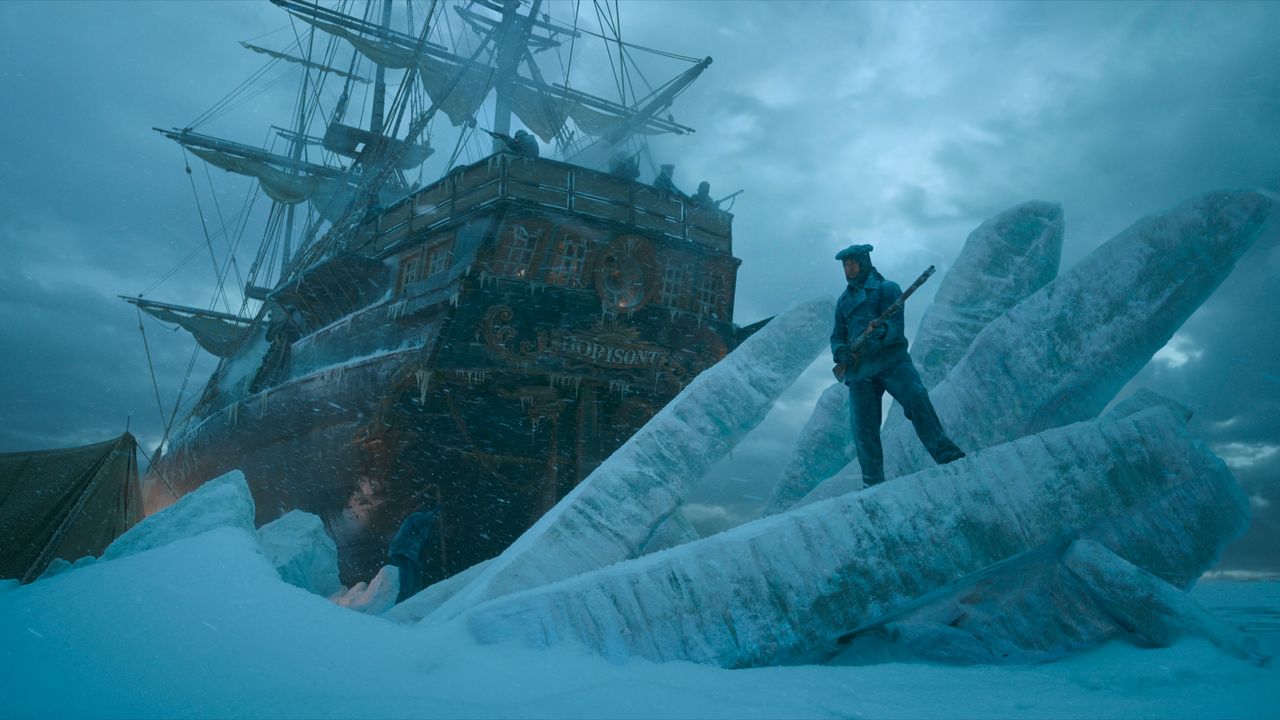
The film begins in the polar wastes aboard the trapped expedition ship Horisont. Rather than find a real trapped vessel, Deverell’s crew built an entire ship on a Toronto backlot and fabricated the surrounding ice. Inspired by historic polar voyages such as the Franklin expedition, they layered metal, Plexiglas, carved Styrofoam, wax, and both artificial and real snow to achieve frozen depth. The set sat on a large gimbal so the deck could pitch during the Creature’s assault. Exterior sled and ice sequences were filmed on a frozen lake north of Toronto; ice safety teams monitored conditions despite unseasonably warm weather.
The family estate
Victor’s ancestral home is an invented estate assembled from several British houses: Gosford House, Burghley House, Dunecht House, and Wilton House all contributed architectural elements. Dunecht supplied a long library that the production refurbished—repolishing floors, adding shelving, and repainting—to get an authentic, lived-in atmosphere that would have been hard to replicate on a stage. Wilton’s grand staircase became a prominent visual anchor. The villa’s design language favors dark wood, greens, marble, and stone, while key personal props—most notably Victor’s mother’s red bed—travel through the story as color cues.
Edinburgh and historic streets
Because parts of Shelley’s novel are set in Edinburgh, the filmmakers shot there to capture the city’s narrow, Gothic lanes. Parliament Square, Writer’s Close, and Bakehouse Close stood in for the cramped, historic neighborhoods along the Royal Mile, even as the crew worked around tourists. Additional location work took place in Glasgow, Aberdeen, and Arbroath. Hospitalfield House in Arbroath doubled as Henrich Harlander’s home; the production even built a period-appropriate bathroom to fit the scene requirements. For a large circular operating-theater sequence, genuine surviving theaters proved scarce, so the team studied London’s Old Operating Theatre and Berlin’s historic veterinary anatomical theater and then designed a set that echoed architectural motifs found in Glasgow City Hall.
Victor’s laboratory
The Wallace Tower provided the design inspiration for Victor’s laboratory. A full-scale base was erected at the Markham Agricultural Fairgrounds near Toronto, while eight interior sets were constructed in Pinewood Toronto. The tower build required complete blueprints, 3D models, technical drawings, and an 11-foot miniature for shots. Del Toro favored circular symbolism—the “circle of life”—so circular details recur: a Medusa motif, a giant rosette window framing characters, and curving layouts that reinforce the film’s visual themes. Exteriors around the tower were shot in Scotland and augmented with mountain plates from the Canadian Rockies to stand in for the Swiss Alps.
Forest, mill house, and the Creature’s refuge
After the lab’s destruction, the Creature emerges into a wooded landscape. Deverell insisted on a real forest and filmed those scenes in the Rockwood Conservation Area in Canada to emphasize the Creature’s connection to the living world. The mill house where the Creature hides was constructed on a horse farm next to Kleinburg Studios; it was built months in advance to weather and age naturally. The set used hand-applied shingles, plaster, and molded stone that were distressed on-site. A last-minute addition—a Green Man sculpture on the roof—was added to strengthen the visual link between the Creature and nature, a small but meaningful detail that the designer felt completed the sequence.
Across these locations and sets, the production balanced authenticity and invention, blending real historic interiors and exteriors with carefully engineered backlot builds and visual effects to create a world that feels both epic and intimately Gothic.