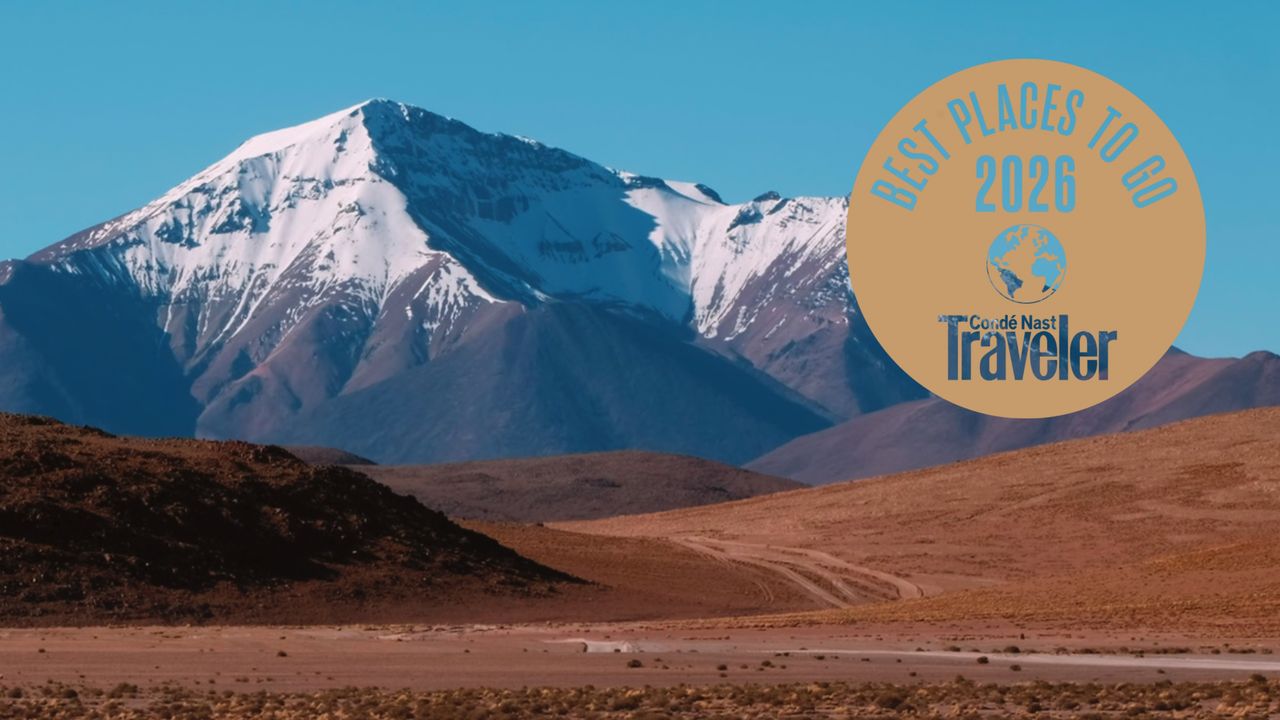

For colorful design hotels, inventive dining scenes, and an otherworldly canyon in the Andes.
All products and listings featured on Condé Nast Traveler are independently selected by our editors. However, we may receive compensation from retailers and/or from purchases of products through these links.
In a region spanning over 7 million square miles, the best places to go in Central and South America simply depend on what you’re looking for. We’re talking about two continents touching two oceans, crisscrossed by surging rivers as mighty as the Amazon and the Paraná, whose lush landscapes and dramatic moonlike deserts are carved by volcanoes, jagged mountain ranges, turquoise lakes, and jaw-dropping waterfalls. Over tens of thousands of years, humans have built thriving cities here—some which remain and others whose longstanding bones we yearn to peek at.
In selecting our annual list of the Best Places to Go in Central & South America, we were, per usual, faced with a wealth of destinations any traveler would jump to visit. What moved us this year were tales of transformation—how one Colombian city continues to evolve as a hub for farm-to-table dining and community-focused urban design; or, how the overlooked capital of Paraguay has begun to draw travelers who previously flew over it en route to neighboring countries, thanks to new restaurants, parks, and boutique hotels. There are also wild landscapes in Northern Patagonia and the Southern Andes, tamed only by new lodges that act as plush launchpads for remote hiking and wildlife spotting. And of course, there are castaway beaches in Central America and off the coast of Brazil, where the palms sway and the living is easy, that will now be quicker to get to courtesy of new train routes and flights. In 2026, what more could we ask for?
This is our list of the Best Places to Go in Central & South America for 2026. Consider it your template for a year very well-traveled. —Megan Spurrell
This is part of our global guide to the Best Places to Go in 2026—find more travel inspiration here.
The Best Places to Go in Central & South America in 2026
Asunción, Paraguay
Go for: a city on the rise in one of South America’s least-touristed countries
The arrival of new cultural centers, creative restaurants, and luxurious hotels make 2026 the perfect time to visit Asunción, Paraguay’s capital city.
Getty
Paraguay, squeezed between Brazil, Argentina, and Bolivia, is one of the least-visited countries in South America. But the landlocked nation has been breaking tourism records of late—seeing a 53% year-over-year increase in international tourist arrivals in the first quarter of 2025.
The capital, Asunción, is an especially burgeoning destination, buoyed by ongoing projects like the effort to revitalize its historic center; new developments like a pedestrian area and dining complex called La Cuadrita and the forthcoming Distríto Perseverancia, a walkable planned neighborhood anchored by a nearly three-acre elevated park, set to open in late 2025; and sustainable infrastructure efforts, including the summer 2025 rollout of new electric buses. But Asunción also has all the makings of a well-rounded city getaway. Young chefs are carving out their own “new Paraguayan” cuisine at creative restaurants: Cocina Clandestina and Pakuri, both spotlighted by 50 Best Discovery; Óga, featured in The New York Times; and Patio Colonial, the latest iteration of the celebrated 13 Fronteras in Buenos Aires, which opened inside a century-old mansion in Asunción this spring. The growing specialty coffee scene—exemplified by favorites like Kaffe’i (opened late 2024) and El Cafetero—gets a spotlight at the annual Asu Coffee Fest. There’s a new energy in the city’s hotel scene too, with grande dames like Gran Hotel del Paraguay, opened in 1921, being joined by newer boutique properties like Factoria, La Misión, and Palmaroga Hotel Asunción (which became the country’s first Hilton property when it opened after a renovation at the end of 2024). Travelers will find no shortage of cultural institutions, including the new Museo de Economía; for a peek at Asunción’s contemporary art scene, head to the Fundación Texo or the La Chispa cultural center. And you can learn more about the country’s Guaraní Indigenous groups at museums like Museo del Barro or the Dr. Andrés Barbero Ethnographic Museum. Indigenous influence is palpable throughout Paraguay, and not only is Guaraní an official language, but the large majority of Paraguayans are also fluent, making the country unique among its South American neighbors. —Hannah Walhout
Chiriquí Province, Panama
Go for: castaway vibes, marine reserves, eco-resorts

On Panama’s Pacific coast, luxurious hideaways like Isla Palenque Luxury Resort—which will introduce new villas in 2026 and 2027—are quietly expanding their offerings to maintain the region’s castaway vibes, with the comfort that well-heeled travelers seek.
Isla Palenque
The Chiriquí Province, roughly 300 miles southwest of Panama City and hugging the Pacific, has emerged over the past decade as a castaway-style escape. The area includes La Amistad International Park, an over 400,000-hectare UNESCO World Heritage Site and Central America’s largest nature reserve, as well as the Gulf of Chiriquí National Marine Park, home to howler monkeys, armadillos, and, from July to October, migrating humpback whales. Luxury tour company Black Tomato will expand Chiriquí coverage for 2026, offering snorkeling within the marine park, naturalist-guided cloud forest hikes, and bespoke whale watches that are paired with lunch on a deserted island. Hoteliers, too, have taken note, slowly rolling out stays that capture the spirit of this getaway with top-tier amenities: The Cayuga Collection’s Isla Palenque, a 10-key luxury eco-resort, will introduce three two-bedroom villas in 2026 and 2027, all with a funicular and private pools. Getting to Chiriquí is also about to get easier. President José Raúl Mulino announced the forthcoming Panamá-David Railway, a 475-kilometer high-speed rail, connecting Panama City with Chiriquí in under three hours and bypassing the need for small flights or long drives when it opens. —Hannah Selinger
Costa Rica’s South Pacific Coast
Go for: Costa Rica unplugged—this is Pura Vida proper

Kura, a new solar-powered eco hotel, is just one of several properties cropping up in the Costa Rican town of Uvita.
Kura Boutique Hotel

Costa Rica is home to a staggering diversity of wildlife, much of which makes its home in the legendary Corcovado National Park, which turns 50 this year.
Kura Boutique Hotel
In Marino Ballena National Park on Costa Rica’s Pacific coast, there’s a natural sandbar known as Cola de Ballena (“whale’s tail”) thanks to its Y-like shape. It’s only visible at low tide, emerging like a fluke. In much the same way, the once-overlooked town of Uvita is having a similar moment now, suddenly surfacing in full view. Brilliant eco-lodges such as solar-powered ocean-view Kura Boutique Hotel have made tracks into the tropical rainforest, while private villas such as Villa Kañik and Villa Sueño (both in Dominical, 15 minutes from Uvita) bring high-end hospitality—private chefs, wellness specialists, and concierge services—to deliciously secluded locations enveloped by dense jungle. In February 2026, underground music and wellness festival Envision will return to Uvita after a year’s hiatus: The lineup has yet to be announced, but previous performers have included experimental electronic producer CloZee, Sonoma folk soloist Ayla Nereo, and house heavyweight Gordo. Farther south, the 50th anniversary of Corcovado National Park is a reminder of the efforts to keep this place, on the whole, raw and wild: A proposal to increase the number of visitor permits was recently rejected in order to preserve the unique ecosystem, which is thought to contain a staggering 2.5% of the world’s biodiversity. On the border of the national park, in a private reserve so remote it’s only accessible by boat, the new Corcovado Wilderness Lodge is an immersive way to stay, offering jungle treks and marine-biologist-led snorkeling excursions, while off the Osa Peninsula, Isla del Caño’s coral reefs offer some of the best scuba diving in the country. Combine both Uvita and Corcovado with a base at Drake Bay, where 20 breezy new treehouse-style bungalows (all with private pools) are opening at Sandglass property Tibo in 2026. —Anna Prendergast
Fernando de Noronha, Brazil
Go for: the most pristine beaches in Brazil
The isolated archipelago of Fernando de Noronha might be Brazil’s best-kept secret, but a newly renovated airport and new flight routes are making it more connected to the mainland.
Shutterstock
In Fernando de Noronha, a volcanic archipelago over 200 miles off the northern coast of Brazil, black-rock peaks rising dramatically from the sea make it unlike anything on the mainland. Here, turquoise waters are so rich with marine life that spotting a sea turtle, reef shark, or the island’s native spinner dolphins on any given beach day isn’t wishful thinking—it’s guaranteed. This is all thanks to strict environmental protections that keep the beaches pristine, with stretches of sand like Praia do Sancho often ranked among the world’s best. Even so, Noronha’s remote location has kept it largely off the international radar, accessible only via small connecting flights from Brazil’s northeast. That’s now changing: A new direct flight from São Paulo makes the island easier to access, and in 2026 a fully renovated airport will nearly double visitor capacity. Still, most of the island is a protected National Marine Park, meaning the government must regulate how many tourists can enter in order to keep its fragile ecosystem unspoiled—and its beaches uncrowded.
On the ground, restaurateurs are evolving in step with the destination’s growing visibility. Newcomers like Mavi and Chicama have brought Mediterranean mezes and Peruvian bocaditos to a dining scene long limited to regional classics like hearty seafood stews. A new open-air food hall called Vilamarê has also added coffee, pizza, gelato, and burgers in a casual self-service format—a first for the island. Despite these changes, Noronha’s soul remains as roots as ever, to use the Brazilian slang for hippie-spirited simplicity. Yes, the ultra-exclusive hotels like Nannai and Pousada Maravilha offer high-thread counts, but the island’s true magic unfolds outdoors and on the water: sunrise canoeing with dolphins, snorkeling in natural pools, and some of the best diving Brazil has to offer. —Carla Vianna
Medellín, Colombia
Go for: a buzzy dining scene, nonstop nightlife, and innovative city planning
Colombia’s second city is undergoing yet another cultural resurgence, anchored by the arrival of the massive hotel and dining complex Wake, opening in 2026.
Wake Hotel
Few places in Latin America embody reinvention quite like Medellín. Colombia’s second-largest city has, in less than two decades, gone from cartel capital to a model of urban ingenuity. Cable cars and a modern metro stitch hillside barrios like Comuna 13—once considered unsafe for visitors and now a symbol of artistic resilience and a top destination—with tree-lined avenues that spill into the Aburrá Valley.
That energy crests in 2026 with Wake, a $100-million development uniting a wellness hotel, residences, and more than a dozen restaurants and bars—Medellín’s most ambitious culinary venture yet. Its centerpiece is Boro bistro from Jaime David Rodríguez of Cartagena’s acclaimed Celele. At Boro, Rodríguez will translate Colombia’s bounty into plates spanning the Amazon, Andes, Caribbean, Pacific, and Orinoquía. Test Kitchen Lab, the intimate chef’s table by chef Adolfo Cavalie and bartender Daniela Alvarado, rooted in 100% Colombian sourcing, will also move to a bigger location at Wake, expanding with research and fermentation labs that deepen Medellín’s reputation for gastronomic innovation. Other highlights include Wake BioHotel, built around the concept of “wellness meets science,” with 109 rooms and a longevity center, in a first for the continent. The larger complex also brings in heavy-hitters like Osso, Peru’s cult butcher-restaurant, alongside spots such as Chez Migú, Somos Masa, and Krudo Viches y Vinilos—underscoring the project’s ambition to become a culinary city within the city. The exact opening date has yet to be confirmed, with timelines that range from March to April 2026. But when Wake does open, it’ll be hard to miss. Chefs here are proving Colombian food can be as inventive and layered as the country itself.
Call it one of the most exciting food cities in South America right now, with the nightlife to match. —Allie Lazar
Minas Gerais, Brazil
Go for: modern art, rich culinary traditions, and a capital city on the rise

The Inhotim Museum in Minas Gerais, one of Brazil’s largest states, can now host even more design-lovers thanks to an expanded on-site hotel—just one of several reasons to visit the state in 2026.
Inhotim Museum
Brazil is almost a continent in itself, with regions as diverse as the palm-fringed beaches of the northeast, vineyards tucked into the lush valleys of the south, and the vast, wildlife-rich wetlands of the Pantanal. Yet with its deep culinary traditions, echoes of colonial architecture, and famously warm hospitality, Minas Gerais, one of Brazil’s largest states, is among its most overlooked treasures—at least to an international audience.
The capital city of Belo Horizonte has been quietly transforming into a top destination, fueled by its vibrant boteco culture centered around the no-frills, often anonymous bars serving great food and always-ice-cold beer. Much like the bistronomie movement in Paris, young chefs are reimagining regional classics in modern spots such as Bar Pirex, from Caio Soter, and A Porca Voadora, from Bruna Resende, while the city’s art scene continues to flourish. The architectural team behind Mercado Novo—the cultural and gastronomic hub that helped reshape the city’s urban fabric over the past decade—is now launching Galeria Ficus, on a charming square in the Carlos Prates neighborhood. Housed in a restored manor house, this hybrid project will feature seven shops and a cocktail bar, aiming to bring new life into the historic space.
In the lively Savassi district, newly relaunched Albuquerque Contemporânea is quickly establishing itself as a key player in Brazil’s contemporary art scene. By highlighting rising local artists like Mateus Moreira (who will open an exhibition in March 2026) while also representing internationally recognized Brazilian names such as Ana Maria Tavares, the gallery is helping place the city on par with cultural hubs like São Paulo and Rio de Janeiro. Accor is getting in on the creative action and opened its first Tribe hotel in Brazil here in September 2025.
Just outside the city (1.5 hours by car), Inhotim, Latin America’s largest open-air art museum, home to 800 works by more than 50 artists from 18 countries, will celebrate its 20th anniversary in 2026, with new exhibitions in April and October. The on-site hotel, the Clara Arte Resort, inspired by Japan’s Benesse House, is also expanding, with 30 additional rooms planned to open by August 2026 along with a spa set in the middle of the forest. The hotel also offers intimate guided experiences just for hotel guests on Mondays and Tuesdays, when the museum is closed to the public. —Rafael Tonon
Northern Chilean Patagonia
Go for: a storied backcountry lodge and wellness experiences in “Green Patagonia”

Luxury lodges and adventure camps like Tawa Refugio del Puelo (pictured above) provide a home base for travelers exploring the northern reaches of Chilean Patagonia.
Tawa Refugio del Puelo/NGB Photo
The skyscraping spires of Torres del Paine National Park, at the southern tip of South America, carry legendary status among global adventurers, but for those seeking less-trodden trails, the greener wildlands of Northern Patagonia in Chile remain blessedly unexplored. The newest reason to visit? Reñihué, a vast fjord-side sanctuary set amid turquoise rivers, craggy peaks, and misty rainforest trampled by kodkods (the continent’s tiniest wildcats) and pudus (the world’s smallest deer). American conservationists Doug and Kris Tompkins started their pioneering work—which resulted in the creation and expansion of 15 national parks across Chile and Argentina—with a 1,750-acre land purchase in this valley. Fellow American Charlie Clark later acquired the property, launched the Reñihué Nature Conservancy Foundation, and, over the past year, turned the wood-shingled Tompkins home into a bookable four-room lodge overlooking the glaciated Michinmahuida Volcano.
The Reñihué opening arrives amid a flurry of regional conservation wins since 2024, when local activists saved the so-called Yosemite of South America from property developers, protecting its granite domes (beloved by rock climbers) in the new Cochamó Valley Nature Sanctuary. The nearby Puelo and Futaleufú Rivers are set to become the first two protected waterways in Patagonia in early 2026, which will safeguard these milky-teal icons (revered by whitewater rafters) from energy exploitation. Meanwhile, thrill-seekers can rest their weary bones at the Ritual Patagónico Spa opening this austral summer at the lush Termas del Sol hot springs complex; it’s right by the Puelo River and near the striking eight-room adventure lodge Tawa Refugio del Puelo, which opened in 2023. —Mark Johanson
Potosí, Bolivia
Go for: a big-deal lodge opening, luxe experiences amid otherworldly landscapes

The Uyuni Salt Flats aren’t only for backpackers these days, thanks to new lodges and elevated experiences from local tour operators. Take Hidalgo Tours, who are now coordinating activities like a meal upon an apthapi—communal table—right on the reflective salt pans.
Apthapi de Lujo
Bolivia’s star attraction has long been the otherworldly Salar de Uyuni, 4,000 square miles of glistening crust left behind when prehistoric lakes evaporated that make up what is, today, the largest salt flat in the world. There’s a magnetism to this blinding-white expanse perched 12,000 feet high in the Andes. But in greater Potosí, the municipality that encompasses the flats, this is far from the only surreal landscape. Eduardo Avaroa National Reserve stuns with its sculptural Valle de las Rocas; the blood-red waters of Laguna Colorada, a small 85°F hot-spring pool called Termas de Polques; and the emerald Laguna Verde shimmering beneath the snow-capped Licancabur volcano. Here, deserts are pocked by geysers and steaming geothermal fields with bubbling silver pools. Multiday jeep tours have long bumped along the roads, transporting travelers to see these alien-like landscapes, while offering front-row views of vicuñas grazing and flamingos taking flight.
But now new hotel projects and better infrastructure are transforming the region, making it more appealing to travelers seeking comfort—and helping it shed the long-held backpacker-only reputation. Local outfitter Hidalgo Tours now offers new, high-comfort excursions through Potosí, with 4x4s and a custom luxury van featuring business-class-style seats, onboard champagne and snacks, and even a proper bathroom—plus the option of a meal upon an apthapi (a traditional Andean communal table) right in the middle of the flats. Crillon Tours, meanwhile, offers a three-day itinerary from the small village of Coquesa to the Green Lagoon with deluxe accommodations in a silver Airstream camper. For the adventurous the Ultra Bolivia Race, a 220-kilometer foot race across salt flats, desert plains, and high-altitude lagoons, returns in September 2026. Around Uyuni in particular, a wave of design-forward stays is redefining what it means to sleep amid the stark beauty of the desert. Explora runs three minimalist mountain lodges in Ramaditas, Chituca, and Jirira—striking, sustainable properties surrounded by ethereal landscapes. In Jirira, the tiny town celebrated as the birthplace of Bolivia’s prized gold quinoa, the biggest opening of all is forthcoming, thanks to Casa Gastón. Come March 2026, the museum-hotel hybrid is set to open its doors in the foothills of Tunupa volcano. Designed by the late artist Gastón Ugalde, considered the father of contemporary Bolivian art, the property will blend ancient building techniques with contemporary design across 10 suites, while offering immersive experiences rooted in sustainable tourism. —Rafael Tonon
Santiago, Chile
Go for: a new approach to the mercado, cool hotel bars, sustainable design

Beatriz Solari and Karla Martínez are the duo behind Siam Thai in Santiago, which was honored on the 50 Best Discovery list for its cocktail program.
Siam Thai

AC Kitchen from renowned Spanish chef Sergio Barroso Urbano is one of Santiago’s bold new fine dining establishments.
AC Kitchen
Santiago has long been overlooked by visitors bound for adventures in Patagonian fjörds or the Atacama desert. But the Mercado Urbano Tobalaba (known as MUT), inaugurated in 2023, has slowly but surely changed that dynamic. This innovative urban market was built atop the capital’s busiest metro station, in the Las Condes neighborhood, and has sustainability at its core: The low-carbon construction of timber and recycled steel, whose design by KPF architects brings together green and retail spaces across four connecting towers, runs entirely on clean energy and circular-economy principles by recycling water and eliminating waste and pollution. More than 300 trees were planted throughout the (1,937,500 square-foot, 13-story property, and there is parking for 2,000 two-wheelers. Since opening, the innovative “micro-city” has redefined neighborhood markets, with cheesemongers and butcher stalls placed alongside outposts from the country’s leading chefs, including Carolina Bazán (Ambrosia Bistro) and Camila Fiol (Fiol Dulceria). (It’s certainly a step up for Bazán, who can now serve three times the number of diners seeking the French-inspired omakase at her vibrant kitchen counter.) MUT’s opening is just one factor contributing to Santiago’s foodie moment: Hip chef Pedro Chavarria boosted his intimate nine-table spot DeMo with a second outpost at the Hotel Magnolia, while renowned Spanish chef Sergio Barroso Urbano opened AC Kitchen at the Las Condes–based AC Hotel Santiago Cenco Costanera. The bar scene is also flourishing: The March 2025 opening of Club Siete at the W Santiago hotel gave the city a fun late-night spot for drinking on the dance floor—plus, it’s conveniently located just a few steps from the restaurant Karai, from Mitsuharu Tsumura (whose Lima restaurant, Maido, won Best Restaurant in the World for 2025). Meanwhile, Siam Thai and its notable Asian-inspired cocktail list caught the eye of 50 Best Discovery this year, meaning this is the spot to hit before it’s too hard to get in. —Sorrel Moseley-Williams
Tinajani Canyon, Peru
Go for: a red-rock wilderness anchored by a new luxe safari-style camp

Peru’s otherworldly Tinajani canyon, where a new safari-style camp has been opened by hospitality brand Andean, showcases a lesser-known corner of the country.
Tinajani Canyon
In a red rock canyon, between the high-altitude destinations of Cusco and Lake Titicaca, lie the six safari tents that make up Tinajani, a luxe “camp” opened in June 2025 by Andean, the Peruvian hospitality brand behind some of the country’s finest stays. The arrival of this high-design adventure lodge—replete with explorer-chic antique furnishings, alpaca blankets, and tart pisco cocktails—puts a spotlight on one of Peru’s least-visited corners, the namesake canyon that’s home to significant pre-Inca rock formations but previously called on only by intrepid backpackers. The journey to Tinajani Canyon (altitude 12,900 feet) is very much a part of the adventure: You bumble down dusty roads, passing time-stuck adobe villages, Andean volcanoes, and herds of fluffy llamas before arriving.
It can be tempting to reach Tinajani via Cusco, where the new Chinchero International Airport is expected to open by the end of 2026 in the Sacred Valley (an even closer entry point to Machu Picchu than the current Cusco airport). But the new airport is expected to double passenger capacity to the already densely touristed region, so savvy travelers might want to look for greater rewards elsewhere. Avoid the masses and make your way to Tinajani via Peru’s second-largest city, Arequipa, stopping at two other Andean properties that allow travelers to follow a circuit of Southern Peru: Start at Cirqa, which sits in a converted 16th-century Arequipeño monastery (and previously appeared on Condé Nast Traveler’s Gold List), and then head to tented camp Puqio, which opened in the scenic Colca Valley in 2024. —Mark Johanson

Megan Spurrell is the Associate Director of Articles at Condé Nast Traveler, where she writes and edits travel features on trends, emerging destinations, and experiences worth traveling for—from free-diving in Hawaii, to trekking through archaeological sites in Peru’s cloud forest, to salsa-ing through Mexico’s oldest dance halls. Originally from Los … Read More