









My first trip to Venice came just after pandemic travel restrictions eased. Months cooped up at home had me eager to visit every place I’d postponed, and as an Italian travel writer who had never set foot in one of the world’s most famous cities, Venice topped the list. That first visit felt unreal—canals and cobbled streets mostly empty of tourists, beautiful and almost cinematic. By my second visit, arriving at Santa Lucia station, I knew the city would be busier: gondolas, crowds, and the usual tourist bustle.
I wanted immersion rather than a hotel experience, so I went hunting for authentic lodgings. Finding Palazzo Cristo San Marco on Airbnb—a 15th-century palazzo a few minutes from Piazza San Marco that had been completely and tastefully remade—was a revelation. The photos hinted at its grandeur, but nothing prepared me for the scale and the detailing in person.
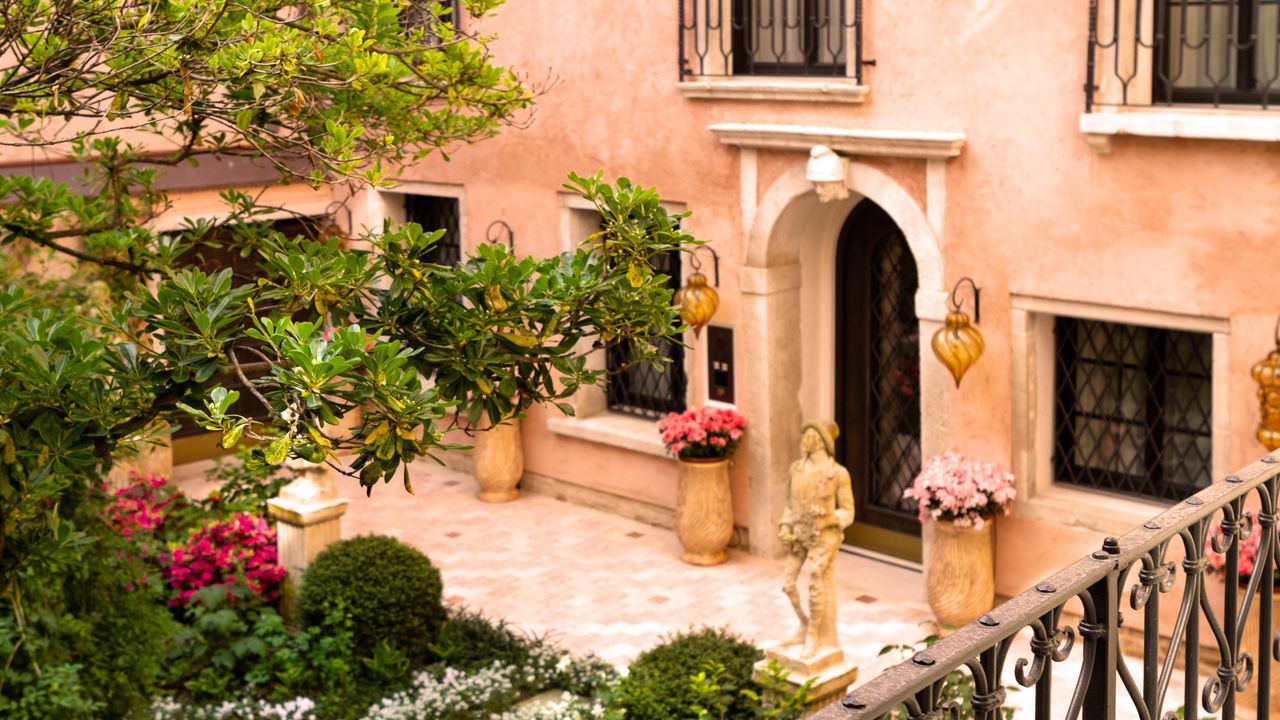
Instead of taking the vaporetto, we walked about half an hour from the station through Cannaregio and slipped into a narrow street where the entrance is tucked away. What looks like an old gate conceals a modern entry system. Beyond it is a riad-like inner garden: abundant pink blooms, a fountain, 19th-century statues representing the four seasons, and benches arranged for quiet. It felt like a secret pocket of calm set within the rosy walls of the palazzo.
The restoration is the second major project by architects Anna Covre and Frederic Tubau de Cristo—their first, Palazzo Cristo Castello, is nearby. The renovation took seven years and cut through a lot of bureaucracy, but the outcome is a thoughtful balance of contemporary comfort and historical character.
The building houses six large, self-contained suites that can be rented individually or as an entire palazzo (during big events such as the Venice Film Festival it must be booked in full). There’s even a private boat entrance on the canal, which is why the concierge had recommended a water taxi: a rare and charming way to arrive.
Suites vary from roughly 969 to 1,421 square feet and most include fully equipped, modern kitchens. Two ground-floor rooms open directly onto the garden and can serve as extra sleeping space for larger groups. We took the elevator up to Suite IX. The interior is a contemporary interpretation of Venetian style—clean, modern lines layered with local references.
Large windows in the living area open onto the garden, letting in summer light and birdsong while muting the street noise. The color palette draws on Venice’s terracotta and rosy hues. Soft furnishings are in velvety Rubelli fabrics; bespoke furniture in white marble, oak, and walnut was designed by the architects and made by local craftsmen. All the glass—garden lights included—was mouth-blown in Murano. Mirrors pick up the shapes of Venetian windows, and wooden partitions and screens echo local patterns.
The bedroom featured an exceptionally comfortable bed dressed in luxurious Italian linens. The bathroom felt almost regal: exposed beams and an original brick wall, twin Carrara marble sinks, Aesop toiletries, a soft robe, a walk-in marble shower, and a bathtub that invited a long soak after days exploring the city.
Whether we were out for a romantic dinner at a top restaurant or lingering over Aperol spritzes, returning to the palazzo was a highlight. Sitting on the balcony with a morning coffee on our last day, I realized those two days had been a restorative escape—the kind of stay that makes a vacation feel complete.