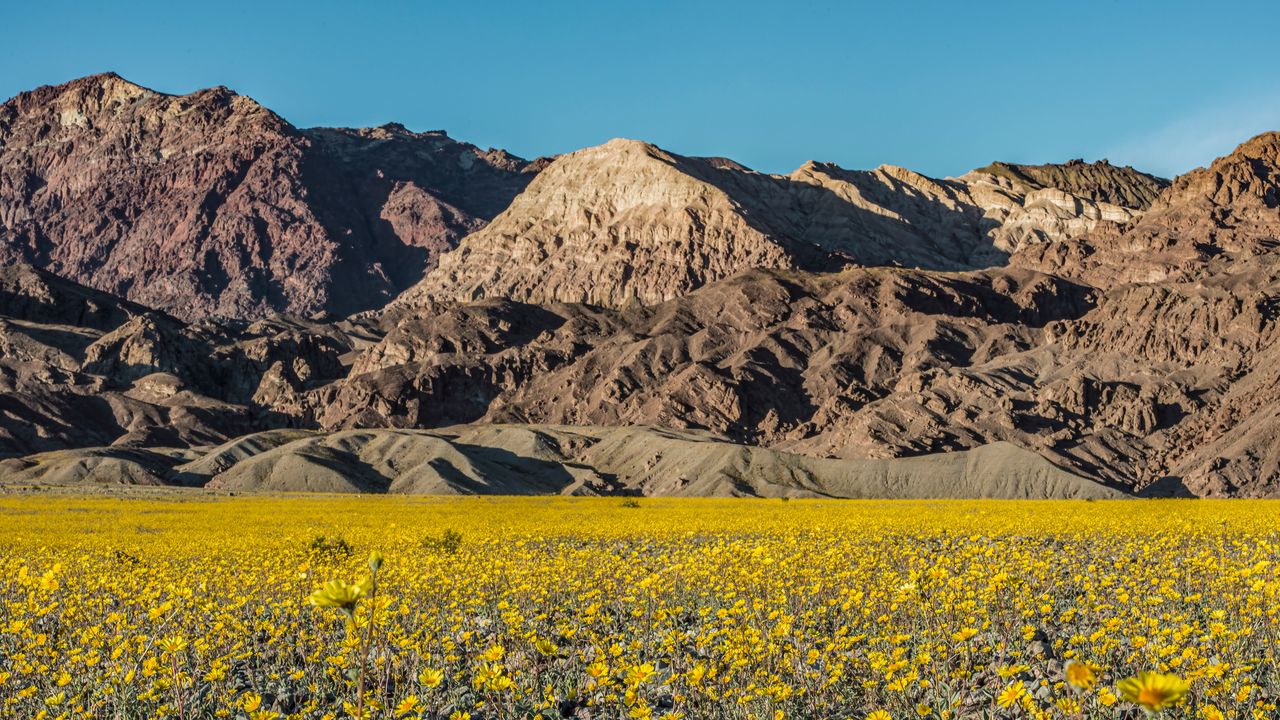

Death Valley, California—the hottest and driest place in North America—is rarely associated with flowers. Its salt flats, jagged canyons, and sand dunes usually test endurance rather than delight the eye. Yet after an unusually rainy 2025, the desert is showing a side few expect: colorful and vibrantly alive.
Record rainfall this past autumn—2.41 inches across the valley—soaked dormant seeds and washed away protective coatings, giving annual wildflowers the moisture they needed to sprout. Most of Death Valley’s wildflowers are ephemerals that lie dormant for years and then bloom quickly when conditions allow. The National Park Service calls this “the best blooming event the site has seen since 2016.”
Swathes of the park are carpeted with desert gold, violet sand verbena, brown-eyed primrose, and flashes of grape soda lupine. Low-elevation blooms are already in full display through mid- to late March, with higher elevations following in April and stretching the desert’s awakening into early summer. Bees, butterflies, moths, and hummingbirds are taking advantage of the abundance, turning the usually quiet landscape into a brief, buzzing ecosystem.
NPS urges visitors to respect the fragile terrain: do not pick flowers; park fully off road shoulders; watch for deep sand and uneven edges; and avoid touching plants that can irritate skin. Spring brings heavier visitation, so expect limited parking and crowds at popular viewpoints.
Officials are cautious about the term “superbloom.” While this event isn’t as massive as the record years of 1998, 2005, or 2016, it’s far more abundant than most years and typically peaks in March. Even without blooms, Death Valley’s sculpted badlands, silent dunes, and vast salt flats remain striking; the wildflowers are a reminder that the desert’s starkness is not emptiness—life persists on its own terms.
Where to stay near Death Valley
The Oasis of Death Valley, made up of The Inn at Death Valley and The Ranch at Death Valley, offers a luxurious base with a golf course, spa, spring-fed pools, and resort tours and activities like mountain biking and jeep drives. Nearby Airbnbs include a one-bedroom ranch in Lone Pine, a desert ranch home in Beatty, Nevada, secluded eco-pods in Ridgecrest, Nevada, and the Desert Gold House in Beatty.
Best viewing spots
Head to Badwater Road in the south end for wide-angle shots of desert gold against white salt flats. Zabriskie Point’s hills and washes show sand verbena and pink lupine, especially at sunrise or late afternoon. The park entrance sign also offers a striking contrast of blooms against barren landscape.
When to visit
Low-elevation fields are best from mid- to late March. Higher-elevation displays are likeliest from April through June. For peak viewing now, early mornings on weekdays give the best light and fewer crowds.