





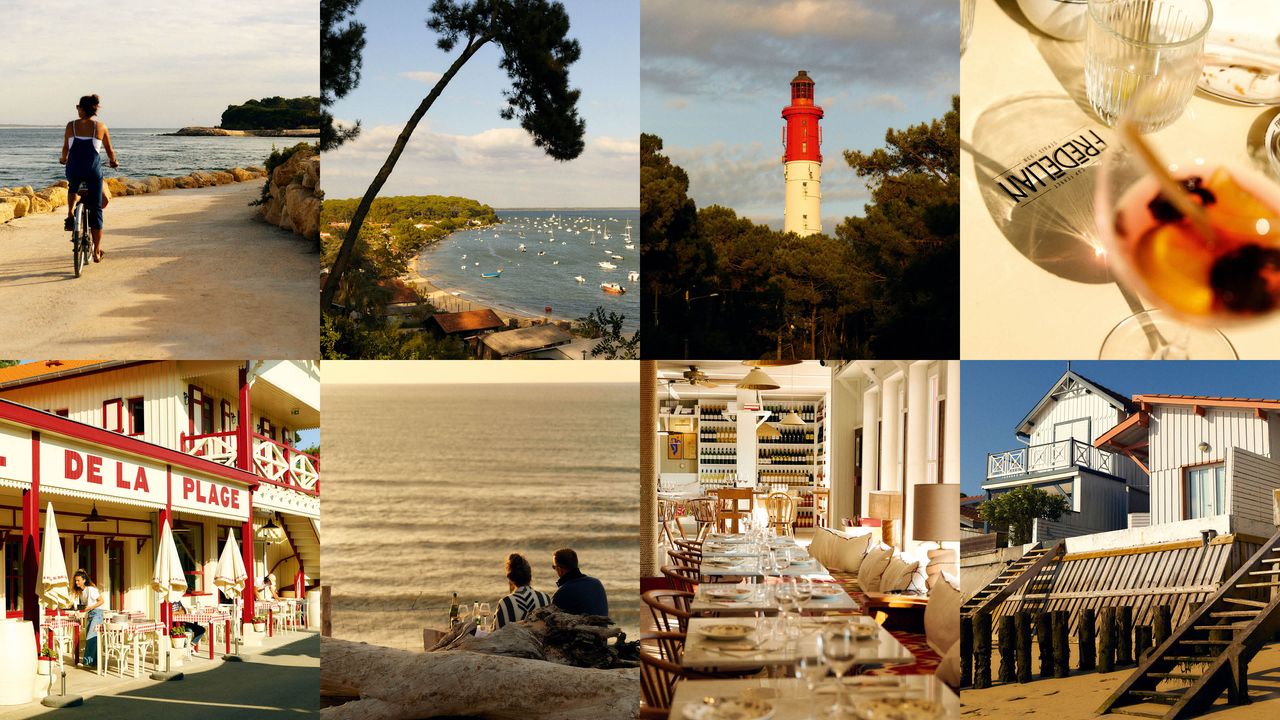
I arrived on a windswept night, driving along the peninsula on a single lane road through a stand of pines. Their resinous scent filled the car and, by morning, became the place’s signature — an earthy, clean note that accompanied every walk and ride. Though Bordeaux is only a short plane ride from London, Cap Ferret felt remote: at times more like Cape Cod or New Zealand, where the farther you go the fewer human traces remain and the horizon widens as the land falls toward the sea.
Cap Ferret’s pleasures are elemental: oysters rather than pearls, surf spray rather than glitter. Its name invites comparison with the glamorous Cap‑Ferrat on the Côte d’Azur, but the two could not be more different. The cape is a modest, workmanlike kind of elegance — less about display than how things are made and used.
I stayed in Villa de la Pointe, a white wooden cabane whose plain exterior hides a high‑raftered interior of rattan and bamboo, tiled floors that open onto a pool and a pétanque court. That relaxed, unforced style is everywhere here: houses and shacks that care about comfort and craft more than ostentation.
Geography shapes the mood. The peninsula is a narrow tongue pointing into the Atlantic, splitting two coastal worlds: the tide‑ruled calm of Arcachon Bay on one side and the raw Atlantic on the other. That division creates microclimates and wildly different beaches within miles — or even yards — of each other. Around the village the atmosphere is convivial and villagey; head west and it turns surfy and bohemian. A 20‑minute bike ride brought me to Plage du Truc Vert, a vast, uncrowded sweep of sand that felt like Byron Bay: long, white, and nearly empty, where surfers hunt the swell and the occasional relic of the Atlantic Wall punctuates the dunes.
A short boat trip across Arcachon Bay puts you at Dune du Pilat, a luminous, rippling dune that reads like a desert dropping into the sea. Formed over millennia, the dune slowly creeps inland, swallowing pine forest one windblown year at a time. Nearby La Coorniche, Philippe Starck’s hotel, offers immaculate service and panoramic views — an elegant, designed response to the dune’s rawness.
Local stories are part of the landscape. People here still speak of Benoît Bartherotte, who owns La Pointe — the cape’s tip where bay meets ocean. French law limits privatization of beaches, but Bartherotte is credited with saving the tip from erosion in the 1980s with inventive engineering. His house is a battered beach shack filled with mementos and grandchildren’s drawings. “I am attached to this land,” he told me. “The sky and the sand. You can never forget that you are living on a planet when you’re here.” His mother summed it up simply: “Cap Ferret is like a holiday from the holiday.”
That quiet detachment is the place’s charm. The cape lives the old French motto of hiding to be happy — long, slow mornings, small, contemplative rituals, and a communal casualness about time. At Frédélian, an Art Deco café open since 1939, the co‑owner shrugged when I asked whether they stay open all year: “Depends how busy it is.” That laissez‑faire tempo felt everywhere.
To the north is L’Herbe, an oyster‑farming village of whitewashed cabins with brightly painted shutters. The menu is simple — oysters, white wine, pâté, shrimp — but the sea gives extraordinary produce. Where freshwater meets salt and phytoplankton blooms, oysters grow with a briny, floral quality prized across France. Watching farmers haul beds from the bay, shuck with astonishing speed, and hand you a half‑dozen paired with a crisp local white is an elemental, immersive pleasure.
I met Estelle, a young oyster farmer at Le Monte à Bord, who spoke candidly about the trade’s pressures. Subsidized housing exists for workers but is limited; many younger farmers struggle with precarious housing and little room to expand. The future of Cap Ferret’s oysters depends on supporting people like her.
A brighter story is La Cabane D’Hortense, run by Khalid Zamrani. Perched above the Conche du Mimbeau bay, the shack is warm and inclusive. Zamrani — whose father was an imam and who grew up between cultures — started as a dishwasher and worked his way up. He blends service and friendship, farming oysters, serving them affordably, and running a place where staff and regulars mix, jokes are common, and hierarchy fades.
My final night fell on the village fête, the informal closing party of high season. Locals and regulars gathered to drink, dance, and mark summer’s end. On the dance floor, to surf, Boney M, and generations of neighbors, I felt briefly part of the motley community I’d watched all week — farmers, restaurateurs, villa owners — and almost forgot I would have to leave.
Where to stay
– Le Collectionist Villas: A range of private villas with optional chefs and staff. Villa de la Pointe sits near La Pointe and the beaches; Villa Dorea is stylish and tucked away; Villa Omnia has a library, gym, and a private path to the ocean.
– La Coorniche: Philippe Starck’s hotel in Pyla‑sur‑Mer with views over the bay, an infinity pool, and seafood‑forward dining. Lodgings include the main house and oyster‑shack‑inspired rooms.
– Hôtel de la Plage: In L’Herbe, a restored pine‑resin workers’ dormitory with 12 colorful rooms close to the oyster farms and a café serving both seafood and hearty dishes.
Where to eat
– Oyster shacks of L’Herbe: The most authentic experience — white cabins with colorful shutters serving oysters straight from the bay. Le Monte à Bord overlooks Arcachon Bay.
– Chez Hortense: Known for moules‑frites and fresh bay fish, with a terrace near La Pointe and casual, friendly service.
– La Cabane D’Hortense: Khalid Zamrani’s egalitarian spot, serving oysters and rosé at modest prices in a convivial setting.
– Cap Ferret market: The traditional market in Lège Cap‑Ferret hosts about 130 stalls selling produce, baked goods (try the dune blanche at Chez Pascal), flowers, and local crafts — perfect followed by tapas and a glass at Le Bistrot de Peyo.
– Mayzou: For a younger crowd and playful, pan‑Asian‑leaning cooking from chef Juliette Lacroix‑Wasover, with inventive mains and desserts.
Cap Ferret is a peninsula of contrasts: refined and rough, communal and private, timeless yet always shifting. Its appeal isn’t flashy display but the basic, unforgettable things — sky, sand, sea — and a community that treats life here as a deliberately kept secret.