




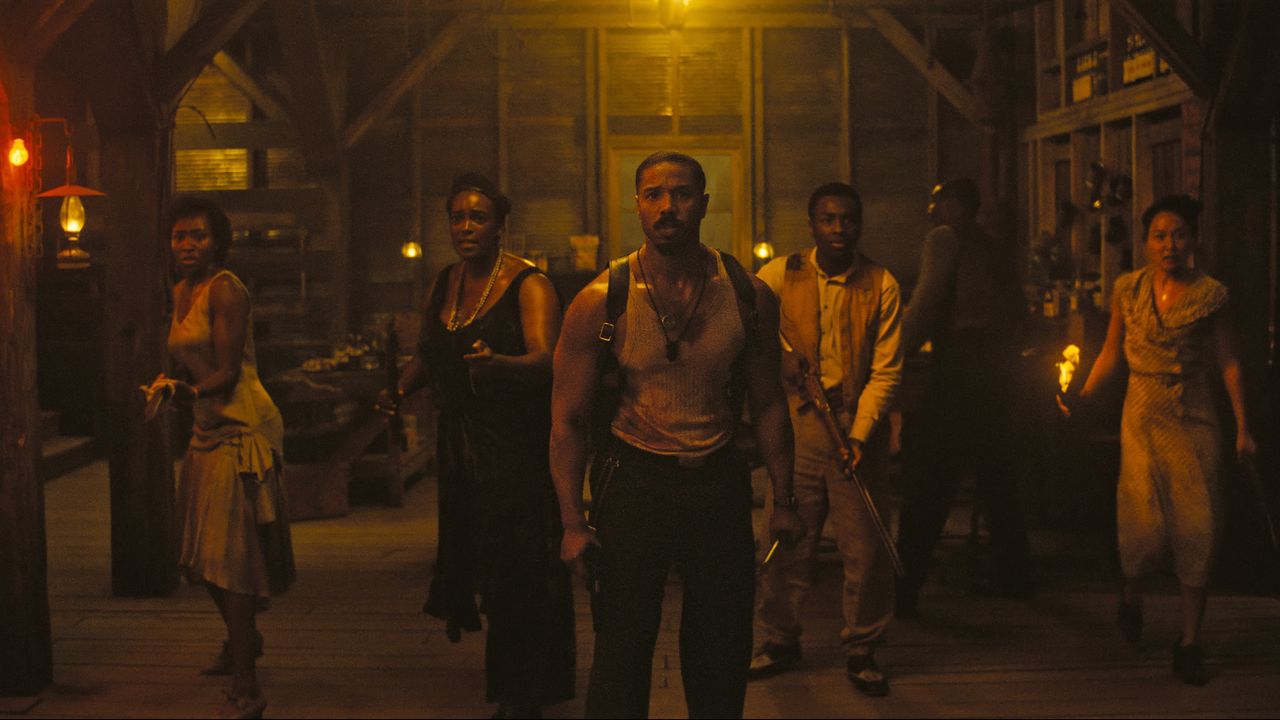
Sinners is defined by moody, intense Southern Gothic visuals that linger long after the credits roll. The film, which broke records to become the most nominated film ever at the Oscars, director Ryan Coogler’s supernatural horror is set in the Mississippi Delta, 1932. It tells the tale of twin brothers Smoke and Stack (Michael B. Jordan, in a dual role), who return to their hometown of Clarksdale, not far from the Arkansas border, with the dream of opening a juke joint. They enlist local friends to get the operation up and running, blissfully unaware that something evil lurks not far away.
In reality, Louisiana stood in for Mississippi. Though New Orleans has made the state known for its lively nightlife culture, its secluded spots and rural countryside are what make their way into the film. For the film’s Academy Award-winning production designer Hannah Beachler, that filming location gave her a chance to recreate a bygone world within the boundaries of a place she knows intimately—she’s been based in New Orleans for two decades. We sat down with Beachler to discuss harking back to 1930s Mississippi through the vehicle of Louisiana, using its charms and topography to build Sinners’ world, and the real-life places that built the film’s look and feel on screen.
The film is set in Clarksdale, Mississippi, but filmed in Louisiana. Why Louisiana for the choice of filming location, and what’s your relationship with the state?
I’ve lived there for over 20 years, originally hailing from Ohio, which I’m also back in a little bit as well. Louisiana has a really great infrastructure for film, with really talented filmmakers. That’s where I started my career, so I’ve done many films there. I came up in New Orleans in the art department, right before Katrina in 2004.
There are a couple different things which made Louisiana perfect. One is proximity to the Delta, and the fact that it has somewhat the same history as Mississippi being its neighbor. In the north, Louisiana also had sharecroppers and still has cotton fields. If we can’t shoot in Mississippi per se, then the next best place that’s geographically and historically similar would be Louisiana. I pitched it to Ryan [Coogler] right away. I was like, “This is going to be economically fantastic, the infrastructure is fantastic, and we’re going to be able to tell the story the way it needs to be told.”
Was there anywhere in Mississippi that you visited to research the imagery and design of the film?
Ryan and I went to Clarksdale and did the research we needed there. I took a trip to Clarksdale through Mississippi, went up the southern Delta to the northern Delta, and went to many towns around Clarksdale—Cleveland, and Mound Bayou, which was the first Black settlement established by free Black slaves in the state.
A lot of research was done at the Library of Congress, looking at images. Ryan was speaking to old blues guys, going to their studios and digging deep with Ludwig [Göransson, composer]. And then we did research talking to people in Clarksdale about what that time was like—stories passed down from family members, like a griot tradition.
There are still a lot of the original buildings from that time and beyond, from the late 19th century and early 19th century. You had at that point in time the richest export in the world coming out of Mississippi, land wealth—wealth times a thousand. But you also had unmitigated poverty at that time. We’re getting into the Depression pretty big around 1932, big businesses like sawmills are going out of business. So you want to paint the picture of what that time was like for the people.
So that’s why we wanted to go to Clarksdale and talk to people who were there, and learn how ethnically diverse the Delta was. Everybody came to pick cotton. That was the biggest export in the United States at that time and they needed as many people as possible, anyone who could live in a sharecropper relationship with the corporation or plantation. Understanding that helps you understand people’s wants and desires. It’s really about knowing the history around slavery and the economy at that time.
Some of the scenes, such as the characters in the cotton fields, were filmed at Laurel Valley Plantation in Lafourche Parish. It has a bit of film history—Angel Heart and others were filmed there—but could you tell me more about selection in terms of its history with enslavement and race?
It was one of the bigger sugar cane plantations, established in the late 1700s. Slavery was there for over 100 years. It has a brutal history. We shot the same little neighborhood area there, and we also built the church on the other side of the road.
Laurel Valley, much like a lot of the plantations on River Road, carries a lot of horrible history. It’s not romantic in any way. So any films made there that tried to romanticize it, that’s not what was held there. And what Sinners was trying to do was tell the truth.
New Orleans is one of the oldest cities in the country. You’ve got the pauper graves you can take tours of, because all the graves are above ground and they date way back. I would even say go somewhere like Oak Alley, which is a plantation. I say Oak Alley specifically because they talk about the history, they tell a more realistic view of what that was like for enslaved people and for people in the city as well.
The central juke joint is a big part of the film, referencing the importance of blues music in the story and the culture of Mississippi at large. Were there any real-life locations you used for reference?
When I went to Mississippi, the hope was there were still some juke joints. They’re a little more mainstream and established now. Back in the day, juke joints were people’s homes or abandoned establishments where you would go and have Prohibition alcohol and listen to music after working 22 hours in a field picking cotton. So we visited a couple juke joints that were still going.
The most famous one is Po’ Monkey’s Juke Joint in Clarksdale. After COVID it kind of went out of business, and now the family has made it a memorial. It’s right near the Crossroads, the famous intersection of Highways 61 and 49 where blues musician Robert Johnson was rumored to sell his soul to Papa Legba. It has a huge history. It was funny finding it, there’s no map. We asked someone and they said, “Go down the road, take two lefts, hit the dirt road, follow it until it ends, take a right, pass two cornfields, then there’ll be a road in the middle.”
We got lost. Finally I saw an old man by his truck and ran over and asked him where Po’ Monkey’s was. We turned down the road and it looked like nothing was there. Then suddenly you see this little shack, covered in decorations people had put there over the years. That’s very indicative of how juke joints were, especially back then. You just kind of had to know.
In Sinners, the landscape helps give the film its eerie feel—the leafy plains, the bushes where the vampires hide, the bodies of water. What about the topography of Louisiana helps create that atmosphere, and what were the spots picked for this?
We have bayous in Mississippi. It’s basically the same topography [as Louisiana], the humidity, the heat. It’s balmy all the time. So things grow a little more tropically and quickly. For the juke joint it was important that it be secluded. It needed to have a body of water near it because that’s how the sawmills floated. So I needed to find where a sawmill would be situated in which it would be profitable, which is by water, because that’s how you float the tree trunks to the mill.
We went down to southern Louisiana, we were in St. Bernard Parish and Plaquemines Parish, and found an old golf course that had been abandoned since Katrina. We were actually the first people in there since, so twenty-something odd years, as long as I’ve been [in the city]. We chopped everything down and found a spot amongst the alligators and the water moccasins, the cottonmouth, and created our own space.
We also needed big landscapes for the field because in Mississippi when you’re driving by a cotton field, you can see probably two miles into that field before you see a tree line. It’s big sky, big country Western feeling, where they have huge deserts with a little something on them like a shack—like John Ford’s The Searchers, Sergio Leone’s Fistful of Dollars, The Good, the Bad and the Ugly—that trilogy with Clint Eastwood was really influential in how we saw the landscape. So it was almost like we were making Clarksdale in this other dimension—the reality of Clarksdale, but something slightly different. That’s what we were aiming to do: create a world based on a world.
You’ve lived in the city for 20 years. When filming, where did you go during your free time?
My all-time favorite restaurant for about seventeen years is Coquette on Magazine Street. It’s one of the best restaurants, I just absolutely love it. There are so many good restaurants, new ones all the time, but I always take producers, writers, whoever I can to Coquette, because it’s such a lovely atmosphere. It’s actually down the street from my house.
Magazine is where all the bars and action are. I live two blocks from that in the Irish Channel, Lower Garden District area. It’s full of shops, full of people, full of life. If you go to the Central Business District downtown at Lafayette Park, you can go to things like the Seafood Festival or the Fried Chicken Festival. They’ll have music and it’s a lot of community.
If you go toward the university area on Carrollton you’ve got Lebanon’s [Cafe] which is my other favorite restaurant. I would eat that every single day. Shout out to the grilled vegetable plate. It’s so funny because I always get their shawarma chicken in it, and they know me well enough now that when I order it the shawarma chicken goes in automatically.
What other spots would you recommend?
We go to City Park all the time. I would take the dogs. There’s a sculpture garden, the art museum is there. It’s just a place where you can walk around and be outside. Of course you have all the filming spots people like to go see. I know some people have tried to find where the juke joint was, maybe not so successfully. But they’ve gone to Donaldsonville to see where we filmed, you also have The Curious Case of Benjamin Button, American Horror Story, and other places people like to visit. So it’s just a never-ending place of entertainment, community, food, and music. I think it’s one of the best cities in the world.